

















Skip to content

DIGITAL PROGRAM

Welcome

It’s a huge pleasure to welcome back the Royal Shakespeare Company to Chicago Shakespeare Theater with Lolita Chakrabarti’s beautiful adaptation of Hamnet. Our feast of Shakespeare continues with a story that has captured the imagination of the world through Maggie O’Farrell’s best-selling novel. This deeply absorbing play gives us a chance to imagine Shakespeare and his life in a completely new way: through the eyes of his wife Agnes and his children. We find so much humanity and emotional intelligence in Shakespeare’s work but know precious little about his life and what might have shaped him as an artist and man of his age. Our adjacent work at CST around Shakespeare created by contemporary writers is perfectly defined by Hamnet. We hope you enjoy being transported back to sixteenth century England and when you surface, that you are inspired to come back and drop into The Merry Wives of Windsor which begins April 2nd. Thank you as always for choosing to enjoy the gift of live theater with us at CST.

EDWARD HALL
Artistic Director

Carl and Marilynn Thoma Chair

KIMBERLY MOTES
Executive Director

presents

The ROYAL SHAKESPEARE COMPANY and NEAL STREET PRODUCTIONS Production of

Hamnet

By MAGGIE O’FARRELL
Adapted by LOLITA CHAKRABARTI
Directed by ERICA WHYMAN

Lead Production Sponsors

Hamnet had its initial production at the Swan Theatre and transferred to the Garrick Theatre from September 30, 2023 until February 17, 2024. A Royal Shakespeare Company and Neal Street Productions production in association with Hera Pictures.

Audience Notice: As a courtesy to the artists and your fellow theatergoers, please turn off your cell phones and all other electronic devices. Photography, video, and audio recording are strictly prohibited during the show. For your safety, we ask that you keep aisles and doorways clear. If you need to step out while the show is in progress, theater staff may ask you to wait in the lobby before re-entering, and it may not be to your original seat. If we can help accommodate you during your visit, please speak with our House Manager.

Cast

Creative Team

Maggie O’Farrell

Writer

Erica Whyman

Director

Prema Mehta

Lighting Designer

Oğuz Kaplangi

Composer

Ayse Tashkiran

Movement Director

Kate Waters

Fight Director

Amy Ball CDG

Casting Director

STAGE MANAGEMENT:

Company Stage Manager Marius-Arnold-Clarke
Deputy Stage Manager Chloe Forestier-Walker
AEA Stage Manager Danny Fender*

ROYAL SHAKESPEARE COMPANY:

Co-Artistic Directors Daniel Evans & Tamara Harvey
Executive Director Andrew Leveson
Executive Producer Despina Tsatsas
Production Coordinator Tom Dickinson
Finance Business Partner Chris Harris
Head of Marketing (London) Nicole James
Senior Marketing Officer Hannah Lord
Head of Media Relations Kate Evans

NEAL STREET PRODUCTIONS:

Producers Caro Newling and Georgia Gatti

PEMBERLEY PRODUCTIONS:

Managing Partners & General Managers Doreen Sayegh & Tim Smith
General Manager Annie Shea Graney
Associate General Managers Rosie Bross-RiceTerri Kohler, & Jimmy Yandoli

UK GENERAL MANAGEMENT:

Simon Woolley for New Road Theatricals

With thanks to: Bruce O’Neil and Hazel Lawrence from RSC Music Department, RSC Casting,
Technical, Finance, and People Departments. Also, thanks to Hamnet UK Rehearsal Stage
Management Evelin Thomas and Josh York

ADDITIONAL PRODUCTION CREDITS:

Production Manager Chris Hay
Associate Director Aaron Parsons
Associate Lighting Designer Claire Gerrens
Associate Sound Designer and Production Sound Charlie Simpson
Associate Production Manager Courtland Evje
Associate Casting Director Arthur Carrington
Costume Supervisor Natasha Ward
Head of Wardrobe Jade Berg
Wigs, Hair, and Makeup Supervisor and Head of Department Georgia Nosal
Production Sound Jimmy O’Shea
Production Carpenter Matt Brewster
Production Electrician Jack Williams
A1 Niki Hulme
Fight Captain Bert Seymour
Voice Liz Flint
Lighting Programmer Stuart Meech

MUSIC RECORDED BY:

Music Director, Viol, Fiddle, Recorder,
Natural Trumpet, Keyboard Alice Brown
Percussion Sidiki Dembele
Lute & Guitar Phil Ward

US General Management & Tour Booking Pemberly Productions
UK General Management New Road Theatricals

*Member of Actors’ Equity Association, the Union of Professional Actors and Stage Managers in the United States.

Hamnet Full Staff Listing

Edward Hall   Artistic Director, Carl and Marilynn Thoma Chair
Kimberly Motes   Executive Director

Philip Macaluso   Lead Concessioner
Patty Roache   Lead Concessioner
Jack Saunders   Lead Concessioner 

Sam Adams   Concessioner
Dani Brown  Concessioner
Suzie Glover   Concessioner
Zoe Maxwell   Concessioner
Tanner McCormick   Concessioner
Robbie Matthew   Concessioner
Leaf McCastle   Concessioner
Lily Mulcahy   Concessioner
Reese Sheldahl   Concessioner
Emily Stipetic   Concessioner
Prenae Thomas   Concessioner
Mo Werder   Concessioner 

HUMAN RESOURCES 

Laurel Legler  Director of Human Resources
Mohad Zahid  HR Generalist 

PRODUCTION
Mac Vaughey   Production Manager
Alexa Berkowitz   Assistant Production Manager 

SCENERY 

Tyler Metoxen   Technical Director
Jesse Gaffney   Assistant Technical Director
Tobi Osibodu   Stage Crew Head
Bradley Buri   Stage Crew Carpenter Head
Jack Birdwell   Stage Rigging Crew Head
Nicolas Cabrera   House Technician
Chris Culver   House Technician
Amber Hahn   House Technician
Bobby Noe   House Technician
Danny Carraher Carpenter
Reese Sheldahl Carpenter
Casey Fort Carpenter
Aubrey Pierce Carpenter
Anthony Doyle Carpenter
Jamie Dolittle Carpenter
Nicholas Thomas Carpenter
Jamie Auer Carpenter
Jessica Howe Scenic Painter
Tea Roberts Scenic Painter  

COSTUMES 

Ryan Magnuson  Costume Department Manager
Cathy Tantillo   Costume Design Assistant
Madeline Felauer   Costume Crafts
Jenn Giangola   Wardrobe Supervisor
Tyler Phillips  Draper/Workroom Supervisor
Teagan Anderson   First Hand
Yas Maple   Stitcher
Naomi Arroyo     Dresser
Alexis Lotspeich Dresser  

LIGHTING AND VIDEO 

Alec Thorne  Lighting and Video Department Manager
Arianna Brown  Assistant Lighting and Video Department Manager
Joan E. Claussen   Lighting Crew Head
Jackson Bettis   Electrician
Andrei Borges Electrician
Emily Brown Electrician
Lea Davis   Electrician
Hannah Donohue Electrician
Elliot Hubiak   Electrician
Christopher Lindquist Electrician
Avery Spellmeyer Electrician
Garvin van Dernoot Electrician  

SOUND 

Nicholas Pope  Sound Department Manager
Tyler Malone   Sound Crew Head
Sarah Ortiz   Sound Technician 

HAIR AND MAKE-UP 

Ashley Adams   Hair and Make-up Department Manager
Sarah Collins   Hair and Make-up Attendant
Anna Gorsuch Hair and Make-up Attendant Cover  

PROPERTIES 

Anna Katharine Mantz Properties Department Manager
Meghan Savagian Assistant Properties Department Manager
Dan Nurczyk Properties Crew Head
Sara Grose Properties Artisan 

Edward Hall   Artistic Director, Carl and Marilynn Thoma Chair
Kimberly Motes   Executive Director

ARTISTIC & EXECUTIVE 

Ericka Ratcliff  Literary Manager
Daniel J. Hess Artistic Administrator
Bob Mason   Artistic Associate/Casting Director
Brian Haas   Company Manager
Alexis Taylor   Casting Associate
Rose Kalef   Executive Assistant
Karina Patel  Literary Associate
Shemar Wheeler  Arts Leadership Fellow

EDUCATION

Nora Carroll  Director of Lifelong Learning & Education, Ray and Judy McCaskey Education Chair
Grace Cummings  Education Programs Associate

MARKETING & COMMUNICATIONS

MARKETING 

Brad Boron   Chief Marketing Officer
Mackenzie Schleyer  Associate Director of Marketing
Katie Bell   Digital Marketing Manager
Olivia George   Graphic Designer
Shelly Binkley   Tessitura Administrator
Ali Khan   Marketing Associate

COMMUNICATIONS 

Hannah Kennedy   Director of Communications
Emma Perrin   Associate Director of Communications
Tiffany Mullins   Digital Content Specialist

BOX OFFICE 

Scott Letscher   Ticketing Services Manager
Sonja Pardee   Box Office Supervisor
Maggie Curry  Box Office Associate
Al Duffy  Box Office Associate
Jaz Fowlkes   Box Office Associate
Micah Hazel   Box Office Associate
Aurthur King   Box Office Associate
Eric Perrine  Box Office Associate
Ash Pierce   Box Office Associate
Kir Westrick  Box Office Associate

DEVELOPMENT & SPECIAL EVENTS 

Stacy Shafer Peterson Chief Development Officer
Makeda Cohran   Events Director
Melissa Rosenberg  Associate Director of Development, Individual Giving
Elizabeth Aranza   Associate Director of Development, Institutional Giving
Finley Jones  Manager of Annual Fund and Planned Giving

FINANCE & OPERATIONS 

FINANCE 

Dan Thomas   Director of Finance
Alysse Hunter   Assistant Controller
Alejandra Sujo   Accounting Associate

TECHNOLOGY 

Jeanne DeVore   Technology Manager

OPERATIONS 

Mark Kozy   Director of Operations
Daniel Lopez   Facilities Manager
Mike Atkins  Custodian
Dwayne Brewer  Custodian
Anthony Davis   Custodian
Cano Hernandez  Custodian
Ferris Robertson  Custodian

GUEST SERVICES 

Devin Faught   Front of House Manager
Phoebe Silva   Assistant Front of House Manager

Julia Ravenscroft   Show Supervisor
Erika Wilson   Show Supervisor

Will Adams   Guest Services Associate
Sam Castillo   Guest Services Associate
Amanda Farmer   Guest Services Associate
Leah Johnson   Guest Services Associate
Paulette Maher  Guest Services Associate
Nat Martinez-White  Guest Services Associate
Maggie Perisho   Guest Services Associate
Jessica Plummer   Guest Services Associate
Jack Porter Guest Services Associate
Nora Rumery   Guest Services Associate
Samantha Waitkus   Guest Services Associate
Nyja White   Guest Services Associate

Philip Macaluso   Lead Concessioner
Patty Roache   Lead Concessioner
Jack Saunders   Lead Concessioner

Sam Adams   Concessioner
Dani Brown  Concessioner
Suzie Glover   Concessioner
Zoe Maxwell   Concessioner
Tanner McCormick   Concessioner
Robbie Matthew   Concessioner
Leaf McCastle   Concessioner
Lily Mulcahy   Concessioner
Reese Sheldahl   Concessioner
Emily Stipetic   Concessioner
Prenae Thomas   Concessioner
Mo Werder   Concessioner

HUMAN RESOURCES 

Laurel Legler  Director of Human Resources
Mohad Zahid  HR Generalist

PRODUCTION
Mac Vaughey   Production Manager
Alexa Berkowitz   Assistant Production Manager

SCENERY 

Tyler Metoxen   Technical Director
Jesse Gaffney   Assistant Technical Director
Tobi Osibodu   Stage Crew Head
Bradley Buri   Stage Crew Carpenter Head
Jack Birdwell   Stage Rigging Crew Head
Nicolas Cabrera   House Technician
Chris Culver   House Technician
Amber Hahn   House Technician
Bobby Noe   House Technician
Danny Carraher Carpenter
Reese Sheldahl Carpenter
Casey Fort Carpenter
Aubrey Pierce Carpenter
Anthony Doyle Carpenter
Jamie Dolittle Carpenter
Nicholas Thomas Carpenter
Jamie Auer Carpenter
Jessica Howe Scenic Painter
Tea Roberts Scenic Painter

COSTUMES

Ryan Magnuson  Costume Department Manager
Cathy Tantillo   Costume Design Assistant
Madeline Felauer   Costume Crafts
Jenn Giangola   Wardrobe Supervisor
Tyler Phillips  Draper/Workroom Supervisor
Teagan Anderson   First Hand
Yas Maple   Stitcher
Naomi Arroyo     Dresser
Alexis Lotspeich Dresser

LIGHTING AND VIDEO 

Alec Thorne  Lighting and Video Department Manager
Arianna Brown  Assistant Lighting and Video Department Manager
Joan E. Claussen   Lighting Crew Head
Jackson Bettis   Electrician
Andrei Borges Electrician
Emily Brown Electrician
Lea Davis   Electrician
Hannah Donohue Electrician
Elliot Hubiak   Electrician
Christopher Lindquist Electrician
Avery Spellmeyer Electrician
Garvin van Dernoot Electrician

SOUND 

Nicholas Pope  Sound Department Manager
Tyler Malone   Sound Crew Head
Sarah Ortiz   Sound Technician

HAIR AND MAKE-UP

Ashley Adams   Hair and Make-up Department Manager
Sarah Collins   Hair and Make-up Attendant
Anna Gorsuch Hair and Make-up Attendant Cover

PROPERTIES 

Anna Katharine Mantz Properties Department Manager
Meghan Savagian Assistant Properties Department Manager
Dan Nurczyk Properties Crew Head
Sara Grose Properties Artisan


RE-IMAGINING AGNES

Author Maggie O’Farrell and adaptor Lolita Chakrabarti discuss how they have come to imagine a different Anne, or Agnes, Hathaway to the version biographers have been inventing for decades—and how important she and her children were to Shakespeare’s success.

Conversation led by PIPPA HILL, Head of New Work and Dramaturg on Hamnet.
Courtesy of the Royal Shakespeare Company and Neal Street Productions

MAGGIE O’FARRELL: What struck me most about her was that we know almost nothing. We know when she got married and when she died. One biographer described her as ‘the wife-shaped void’. For a biographer, the lack of facts would be frustrating but, as a novelist, it felt like an opportunity.  

Originally, I conceived the book to be about fathers and sons, like Hamlet. Then I became sidetracked by the way Anne, or Agnes, has been treated. We’ve only ever been taught one narrative about her: that Shakespeare was lured into a hasty early marriage by this illiterate strumpet who had the nerve to get pregnant. That he ran away to London to escape from her. But I have read every single biography I could get my hands on and there’s no evidence for any of it. I also looked in Shakespeare’s plays: is there any hint to confirm this myth? There’s nothing—the plays are peopled by faithful, highly intelligent wives and lots of marriages that work well. 

I started wondering whether we’d all been wrong about Anne Hathaway. What crystallized it for me was reading her father Richard’s will, where he named her as ‘my daughter Agnes’. Surely, if anyone knows her real name, it would be her father? Have we been calling her by the wrong name for almost 500 years? 

LOLITA CHAKRABARTI: The one thing I knew about her was the detail about Shakespeare leaving her his ‘second-best’ bed in his will. 

MO’F: Yes, this idea that William was insulting Agnes in his will by leaving her the second-best bed! What her detractors never mention is that, by Jacobean law, she was entitled to a third of his huge estate when he died. And of course, the second-best bed would have been their marriage bed, because the best bed in those times would have been reserved for visitors. 

MO’F: Again, this comes from the plays. There is no shortage of female seers in Shakespeare’s plays. As a society, the Elizabethans were incredibly religious and sequestered (it was illegal not to go to church), but at the same time there were strong beliefs in the ‘other’, and in portents or second sight. Such antithetical faiths coexisted alongside each other. 

I can trace my inspiration precisely to the scene in Hamlet where we watch the mad Ophelia. I’ve always wondered whether her distracted grief, and particularly her song (‘He is dead and gone, lady, he is dead and gone…’), is a version of Shakespeare watching his wife grieve over Hamnet’s death. That scene just feels so strong and seems to come from nowhere, like this huge wind blowing through the play. You have to be circumspect about reading too much biography in the plays, but I do think in Hamlet there are several instances where he becomes visible to us as a human, not just as a literary icon. 

Where Ophelia hands out herbs to different characters, and every single plant is a well-known cure for a flaw that she perceives in them, is interesting to me. I read that every household in the 16th century would have had a kitchen/medicine garden, and it was the purview of the woman of the house to dole out those cures for common household ailments. I like to imagine Shakespeare writing that scene with Ophelia and not really knowing which herbal cures did what. How would he know? Maybe he had to ask Agnes—maybe she contributed to that scene. 

All Agnes’ critics joke about how ironic it is that the greatest writer who ever lived was married to someone who couldn’t read. But what daughter of a sheep farmer would have learned to read in those days? What use would it have been to her? With the herbal medicines, and with Agnes’ skills in hawking, I wanted to emphasize that being illiterate doesn’t mean that you’re stupid. There are other forms of intelligence and education. 

LC: My job is to find out what Maggie is saying, and whose story am I telling. When I really examined the book, I began to wonder if, for the stage, I needed to create a physical logic to the story. If I had stuck to the beautiful format that Maggie uses in her novel, we’d be watching a play that jumped around between different decades. In a film, or a novel, that works well but on stage it’s harder: theatre stages are huge machines of set and cast and you don’t want to stop the flow of the story for a scene change or a jump in logic. 

It felt like the right way to go, but then I hit on a difficulty. Ordering things chronologically means that the title character, Hamnet, isn’t born until halfway through the play. It felt like a problem initially, but as I carried on, I became clear that his mother Agnes is the main character. The story is about creativity, how do we create people, what helps us to create art? 

It then became a simple equation of working out how I show you who Agnes was, who Hamnet was and what he meant to her and her husband. The play spans 18 years. So that was also a challenge. 

I often feel quite oppressed by the Shakespearean ‘industry’ and the regard he’s held in because it can remove you from the beauty and immediacy of his work. What’s fabulous about Maggie’s book is that it brings him and his family to us. It shows that these people were not that different to us. Yes, they lived 400 years ago. But I am still able to connect to these people, as a writer, as a mother, as a woman and so much more. It’s amazing to put flesh on the bones of somebody who’s been lionized—who is out of reach of all of us through time and through scale 

– and to bring them back down to earth as a man, a woman, and a family. 

MO’F: Before you begin any book, there’s an overwhelming sense of vertigo when you face the blank page. Certainly, my biggest source of vertigo with Hamnet was writing about Shakespeare. 

It’s a huge responsibility writing about real people, even if they have been dead for centuries. My characters are essentially fictional, but I wanted to honor and respect that they were real, and their bones are lying in Holy Trinity Church. That’s why, in the novel, you never see the surnames Hathaway or Shakespeare. It’s a marker for me, and perhaps for the reader, that these people are a version of how I imagine they might have been. 

LC: Whereas I had more freedom—it was Maggie who had all that responsibility. Reading Maggie’s characters, I understood exactly who I was dealing with. I could take the vastness of the novel and add in new facts (that aren’t in the novel) to make the play live more three-dimensionally

LC: My go-to Shakespearean adviser is Professor Farah Karim-Cooper at Shakespeare’s Globe, who has written a book about hands in Shakespeare. She showed me this extraordinary spreadsheet she created, which contains every reference to a hand or a glove in all of Shakespeare’s plays. John Shakespeare, William’s father, was a glove maker. As writers, you take experiences from your own life and hide them in the play. It can’t be by chance that Shakespeare had a preoccupation with hands—it must have been linked to his dad’s craftsmanship. It felt like a lovely element to incorporate within the play. 

MO’F: There are some writers who do a huge amount of research and then start writing, but I prefer to start, and then might meet a void where I need to do some research. I was a page and a half into writing Hamnet when I realized I had to go to Stratford. The book opens with a little boy coming down the stairs and falling onto the floor. As I was writing that I suddenly thought, what’s the floor made of? I couldn’t imagine. So I went to Stratford. I went round and round all the houses, drawing maps, and asking the guides thousands of questions. 

It’s extraordinary that the houses still exist. We know so little about these people, but yet you can buy a ticket and walk into the Hathaway kitchen or into the room Shakespeare was born in. It seems like the most astonishing piece of luck that these houses still stand. 

LC: You can feel the ghosts in Stratford. Everything suddenly makes more sense when you visit those places: simple things like where people washed, where they ate, who slept where. Those details answer quite a lot of relationship questions that you have when you’re setting up characters on stage. What are the power dynamics and how would they talk to each other? How used to each other would they be? Walking through Stratford and imagining the Shakespeare family here really changed the way I wrote. 

MO’F: When I went to Stratford in 2017, it broke my heart that there wasn’t a grave for Hamnet. I felt that I had to do something. This child was so important—without him, we wouldn’t have Hamlet or Twelfth Night. So, during lockdown, with the help of Annie Ashworth (who runs the Literary Festival), we started negotiating with Holy Trinity Church and the diocese. They agreed that we could have a memorial for Hamnet and his twin sister Judith. In April last year, it finally happened. The vicar delivered a really moving dedication about the deaths of Hamnet and Judith. And now there are two twin rowan trees in the churchyard, both with a plaque displaying different quotes from Shakespeare’s plays. 

MO’F: Twins are a recurring motif, particularly separated boy and girl twins, in Shakespeare’s plays. There’s a scene in Twelfth Night where the two twins reunite after both believing the other one is dead. It’s so moving reading that through the lens of Hamnet’s death. One of the most incredible things I discovered is that the opening night for Twelfth Night at the Globe Theatre was on what would have been the twins’ birthday. 

LC: The way the world has worked up until now, perhaps still now, is that we credit men with the achievement, don’t we? Shakespeare wrote the plays, so we credit him with the genius. But what I love about Maggie’s story is that it shows nobody works alone. A writer is influenced by loves and losses, and the trials and joys of their own life all feed into the work. 

You can’t assume everything is biographical. But there are startling thoughts in Hamlet that I now believe Shakespeare could not have arrived at without Agnes and their children, and the people around them in Stratford. I love this story as a salute to his artistry through all the people around him. 

Genius is facilitated by the support, inspiration and energies of the people around that genius. That became very clear to me in this story. No one creates anything in isolation.   

A NEW PICTURE EMERGING

By Professor Farah Karim-Cooper 

Who do we imagine lived in a Tudor town like Stratford-Upon-Avon? Professor Farah Karim-Cooper looks at the shifting attitudes to, and evidence of, multiculturalism in early modern England. 

When we imagine Elizabethan England, we tend to assume we know what it looked like and perhaps even felt like, thanks to Tudor re-enactment groups, heritage palaces and historical attractions. Plus, numerous period dramas on film and television and stage productions have helped paint a picture of Tudor England that for most of us feels instantly recognizable. We know it as the ‘golden age’ of history, a time of burgeoning exploration and trade; while portraits of Tudor monarchs illustrate the wealth, glamour and glory of an England that was defining itself in opposition to Europe and countries further afield. 

Most familiar of all is the nation’s playwright, who emerged from this defining moment in England’s history as the epitome of Elizabethan exceptionalism. But who else do we imagine when we think of the inhabitants of cities, towns and villages up and down the country? Most of us have been taught that only white, English people lived in England, with a smattering of European visitors—therefore multiculturalism was unheard of, while interracial relationships would have been impossible. For centuries, we have believed that Shakespeare wrote his plays in such an environment, during a period that preceded the transatlantic slave trade, migration and racial diversity. As such, people were divided only by class, sex, wealth or, most contentiously, religion. 

BLACK PRESENCE IN TUDOR ENGLAND 

However, in the last few decades, a new picture has emerged to prove that these prior notions of Shakespeare’s England are false, as well as rife with mythology and historical whitewashing. Archives, when searched less selectively, reveal evidence of migrants making their way to England from Europe, India and Africa. In fact, we have evidence of Dutch, Italian and French communities living in London. And there is substantial evidence that Africans resided, worked, got married, were christened and buried in England too. Such revelations seem remarkable, until we remember that in the 20th century, archaeologists discovered the remains of people from sub-Saharan Africa that date as far back as the third century AD, so there is a history of Black presence in Britain that precedes even Elizabethan times. The Windrush Generation was not the first. 

How do we know this? Historians (like Imtiaz Habib, Miranda Kaufmann and Onyeka Nubia) remind us that Elizabethans were exceptional record keepers and had methods of documenting births, baptisms, marriages and deaths in each parish in the country. This is one type of document that refers to Black people as ‘moors’ or ‘blackamoors’. State papers, letters and, yes, the plays themselves also speak to the racial and cultural diversity of England. Slavery was illegal in England, though that didn’t prevent English sea dogs like Sir John Hawkins and Sir Francis Drake from dabbling in the racial slave trade. While many Black and biracial people in England worked and seemed to be tolerated, the plays of Shakespeare and many of his contemporaries reveal a xenophobic fear and wariness of racial difference within the culture of that time. 

SHAKESPEARE’S INTERRACIAL COUPLES 

Even if we didn’t have the parish records of the number of interracial relationships and children documented, Shakespeare’s works alone reveal enough about the playwright’s own fascination with interracial love and marriage to make us question the past as it has been presented to us. In his first tragedy, Titus Andronicus, Shakespeare not only overtly stages an interracial love affair, he produces a biracial child. Although set in Venice, Othello centers around the clandestine marriage between a Black army general and a white, patrician Venetian lady. Regardless of how you think their marriage broke down, it is clear that their racial difference is objectified both by the racist sentiment in the play and the juxtaposition of facial blackness and whiteness in the devastating scene in which Desdemona is killed. 

The Merchant of Venice concerns itself with the secret abduction of and marriage between a Jewish woman, Jessica, and her Christian lover Lorenzo. Being Jewish was seen not just as a religious difference, but was racialized in pre-modern rhetoric, revealing antisemitism as a form of racism itself. In the same play, Lorenzo reminds the clown/servant Lancelot Gobbo that he had impregnated a ‘moor’, and in such joking reveals the lack of regard for the unnamed, unseen Black woman. Antony and Cleopatra, no matter how hard the history of stage and film has tried to deny it, is emphatically about a white Roman’s love for a Black queen. The event that allows Prospero to raise a storm and bring his brother and the King of Naples to the island in The Tempest, is the marriage of Claribel, the ‘fair’ daughter of the King, to the King of Tunisia. 

‘THE DARK LADY’ 

It doesn’t stop there. The Comedies contain references, jokes and puns at the expense of dark women as they are compared to their ‘fairer’ counterparts. We need only to think of Hermia, who is called ‘Ethiope’ in A Midsummer Night’s Dream and the darker Rosalind in Love’s Labor’s Lost. In his Sonnets, those addressed to Shakespeare’s ‘Dark Lady’ have invited centuries of speculation about who the Lady was. Was it the notorious Lucy Negro, or ‘Black Luce’—a Black woman who was said to have been a brothel owner and who participated in the London theatrical scene? It is uncertain. We may never know the identity of the ‘Dark Lady’, but we can forcefully speculate that interracial love preoccupied Shakespeare’s thoughts throughout his work, plausibly so because he lived in a society that would have been more racially and ethnically diverse than we were ever allowed to imagine.  

FARAH KARIM-COOPER is the director of the Folger Shakespeare Library. She previously served as Co-Director of Education at Shakespeare’s Globe and Professor of Shakespeare Studies at King’s College London. Her book, The Great White Bard: Shakespeare, Race and the Future (2023) was voted top 100 books of 2023 by Time Magazine, NPR and The New Yorker.

HIDDEN FROM VIEW

By Dr. Tara Hamling 

Using the limited records we have, Dr. Tara Hamling shares moving accounts of intimacy, care, and concern behind the doors of the early modern woman’s family home.

There is limited evidence available about ‘ordinary’ women’s lives in early modern England. Women are generally the subject—rather than the author—of historical sources, so we see them through the records produced by men. The personal, domestic dramas of life are mostly hidden from view. Flashes of comment, however, bring home the hopes and tragedies of love, pregnancy and parenthood. 

THE EARLY MODERN CHILDBED 

Given the risks, pregnancy must have been an extremely anxious time for women. But because the childbed was attended by other women, outside the direct control of men, childbirth was also a concern for authorities. Protestant churchmen worried about superstitious practices around the childbed, such as placing talismans or the Bible on the mother’s belly. 

Unmarried women who fell pregnant were a financial burden to a parish, and so were put under pressure to name the father. Midwives were expected to extract the name of the father during labor. If that failed, the mothers could be pressed by officials. These recorded statements sometimes provide intimate details about early modern women’s lives. In verifying the date and location of conception, we are offered glimpses of sexual activity that took place ‘in ye kitchen… in ye evening… it being done in the settle in ye said kitchen whilst [oxes] tongues were boyleing over the fire’. 

FAMILY WELLBEING 

Intimacy before marriage was not uncommon. Courtship could extend over a long period, especially where there was a need to consolidate a living in trade before establishing a household. If couples did not marry until their mid to late twenties, this placed a natural restriction on the number of children they might have. Of successful pregnancies, over a quarter of youngsters died before the age of fifteen. Bizarrely, it was thought that, because of such high mortality, early modern people did not form emotional attachments to their family. In fact, parents expressed distress at signs of sickness in their offspring and devastating grief upon their deaths. 

Advice contained in the book of herbal medicine, The Garden of Health (1598), includes remedies for childhood illnesses, including roots and seeds of peony ‘hanged about the necke of children, is good against the falling sickenesse, and the haunting of the Fairies and Goblins.’ 

A fairy assault could be very physical: the casebooks of astrological physician Simon Forman include diagnosis for a 16-week-old baby, brought by its mother, as ‘fairy stricken & pinched sorely black and blue’. 

Notebooks written by men show genuine concern for the wellbeing of their wives and children. In the 1630s, Northampton attorney Robert Woodford worried about his wife’s sore breasts preventing successful feeding and gave thanks when the infant ‘hath sucked’. He also noted, with alarm, relatively minor injuries suffered by his ‘little’ son Sam—a candle burn near the eye, a foot burned by a warming pan. In one entry, overwhelmed by the recovery of his ailing baby, he prays ‘Continue unto us our children…& keep our affections from exorbitancy’. Woodford feared loss, but also loving his family so much that he could not part with them. 

THE DEPTHS OF GRIEF 

When his two-year-old daughter Elizabeth died suddenly from plague in October 1624, London woodturner Nehemiah Wallington became much distracted in his mind: ‘The grief for this childe was so great that I forgot myself so much that I did offend God in it… and could not be comforted’. Grace, his wife and Elizabeth’s mother, counselled him: ‘Husband I am persuaded you offend God in grieving for this child so much… consider it your daughter’s wedding day and will you grieve to see your daughter go home to her Husband Christ Jesus where she shall have the fullness of joy for evermore? ’ 

Loss could be interpreted as an act of divine punishment or mercy, and in the depths of grief parents wrestled with both possibilities—vacillating between despair, and hope for their own (and their child’s) eventual salvation. The Christian love and care exhibited by Grace may suggest how other parents came together and found their course through the ever-present threat and trauma of losing a child.   

TARA HAMLING is Reader in Early Modern Studies at the University of Birmingham.
Courtesy of the Royal Shakespeare Company and Neal Street Productions.


SEASON SPONSORS

Chicago Shakespeare Theater is proud to recognize the sustaining partnership of our Season Sponsors,
whose visionary support ensures that we live out our artistic mission for audiences today and for generations to come.

SEASON SPONSORS

Chicago Shakespeare Theater is proud to recognize the sustaining partnership of our Season Sponsors, whose visionary support ensures that we live out our artistic mission for audiences today and for generations to come.


The Grainger Foundation

The Jentes Family

Ray and Judy McCaskey

Paul M. Angell Family Foundation

Burton X. and Sheli Z. Rosenberg

The Segal Family

Carl and Marilynn Thoma

Chicago Shakespeare productions are made possible in part by the Illinois Arts Council Agency and a CityArts Grant from the City of Chicago Department of Cultural Affairs and Special Events.

Chicago Shakespeare is a constituent of the Theatre Communications Group, Inc., the national service organization of non-profit theaters; Shakespeare Theatre Association; Arts Alliance Illinois; the League of Chicago Theatres; and Ingenuity, Inc.   

Actors’ Equity Association (AEA), founded in 1913, represents more than 45,000 actors and stage managers in the United States. Equity seeks to advance, promote and foster the art of live theatre as an essential component of our society. Equity negotiates wages and working conditions, providing a wide range of benefits, including health and pension plans. AEA is a member of the AFL-CIO, and is affiliated with FIA, an international organization of performing arts unions. The Equity emblem is our mark of excellence. www.actorsequity.org


About Chicago Shakespeare Theater (CST)

Our Mission

To create vivid, entertaining theatrical experiences that invigorate and engage people of all ages and identities by illuminating the complexity, ambiguity, and wonder of our world.

Shared humanity and unforgettable stories—now THIS is Chicago Shakespeare.

Our Vision

We deliver excellent, powerful, life-changing theater that challenges our preconceptions of everything. We are an open and inspiring destination to meet, talk, and share experience through community and live performance that is available to everyone. We build a better future with those who watch, work, create, and participate.

Our Story

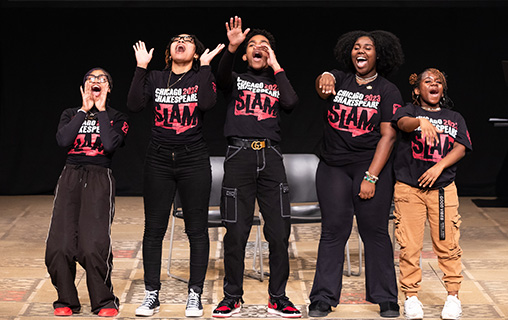
CST is a leading international theater company and the nation’s largest year-round theater dedicated to the works of Shakespeare. Under the visionary leadership of Artistic Director Edward Hall and Executive Director Kimberly Motes, the Regional Tony Award recipient engages nearly a quarter of a million people through more than 12 productions each year. Shakespeare is at the heart of the artistic work, illuminating the playwright as a modern writer for our modern world. CST also produces compelling, contemporary stories from fresh artistic voices of today. CST brings the world to Chicago and sends Chicago out into the world as a presenter of international theater and producer of North American and world premieres. Serving more students and teachers than any theater in the city, CST annually welcomes more than 20,000 students to performances and programs like Chicago Shakespeare SLAM, alongside professional development opportunities for teachers. CST activates its campus with three venues: 700-seat The Yard; the 500-seat Jentes Family Courtyard Theater; and the 200-seat Carl and Marilynn Thoma Upstairs Studio. Free programs like Shakes in the City bring performances to parks and community spaces across Chicago’s 77 neighborhoods. For nearly four decades, CST has distinguished itself with a spirit of innovation, dynamism, and ambitious vision.