|
David Ives (Translator/Adaptor)
Celebrated for his immensely playful and still poignant style of comedy, David Ives situates his aesthetic on the knife's edge between asinine slapstick and astute sustenance. Born in South Chicago, Ives attended Northwestern University before receiving his MFA from the Yale School of Drama. His full-length plays have been honored with a MacArthur Award for Outstanding New Play, the Hull-Warriner Award, a Joseph Jefferson Award, a Prince Prize for Commissioning New Work, and a 2012 Tony Nomination for Best New Play for Venus in Fur, currently running on Broadway.
Ives was first known for his one-acts—he has written over three dozen for both theater and radio. Most are collected in the anthologies All in the Timing, Time Flies, and The Other Woman and Other Short Plays. Perhaps his best known, All in the Timing, is comprised of six short plays of sundry subjects, from a chimpanzee attempting to write Hamlet to the repetitive deaths of Leon Trotsky via axe wounds to the mundane act of composer Philip Glass purchasing a loaf of bread. This grouping won the Outer Critics Circle Playwriting Award, ran for two years Off-Broadway, and in the 1995-96 season was the most performed play in the country after Shakespeare productions.
More recently Ives has played with the works of other great writers, including an adaptation of Mark Twain's Is He Dead? and a translation of Yasmina Reza's A Spanish Play. Often he translates and adapts, inventing and employing new dramatic devices and uses of language that engage in dialogue with the original work. Ives describes this process as "translaptation"—an attempt to "look for the play underneath the words,"—through which he draws comparisons between the era that the play was first produced and the era that we live in today.
His first translaptation was A Flea in Her Ear by Georges Feydeau (the nineteenth-century father of French Farce). Commissioned by CST and produced here in 2006, Flea became the genesis for an entire run of French plays made modern, and perhaps still more absurd, in the hands of Ives. Beginning in 2010 with Corneille's The Liar, a commission from the Shakespeare Theatre Company in Washington, D.C., Ives found he had a passion and knack for turning up the heat on what otherwise may seem a "dreary, unknown, hammer-handed play from the seventeenth century and in French." He went on to "translap" The Heir Apparent (Jean-Francois Regnard's comedy) and, of course, The School for Lies (adapted from Molière's The Misanthrope).
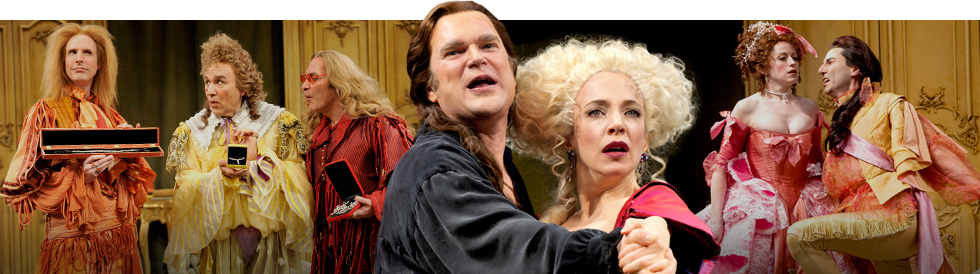
In The School for Lies, Ives remixes The Misanthrope to comment on the foibles of contemporary culture, merging heightened classical language with lowbrow modern references to converge in a comedy of manners for modern audiences. Maintaining rhyming couplets throughout, Ives pays homage to Molière's original masterpiece while departing here, there, and everywhere necessary to speak to the evolution (or, rather, devolution) of society through the past three and a half centuries. For Ives, the process of translaptation requires more creation than renovation. "It's my job to bring to an adaptation the energy of a playwright working on a new play. I've done the work on The Misanthrope that Molière himself might have done had he lived another 550 years."
Ives's other full-length plays include New Jerusalem: The Interrogation of Baruch de Spinoza, Irving Berlin's White Christmas, Ancient History, Don Juan in Chicago, The Land of Cockaigne, and Polish Joke. He wrote the libretto of an opera (The Secret Garden, with music by Greg Pliska, which premiered at the Pennsylvania Opera Theatre in 1991), and has adapted thirty-two musicals for New York's celebrated Encores! series of American musicals in concert. He is also the author of three young-adult novels: Monsieur Eek, Scrib, and Voss. A former Guggenheim Fellow in playwriting, Mr. Ives lives in New York City.
–Contributed by CST Education Department |